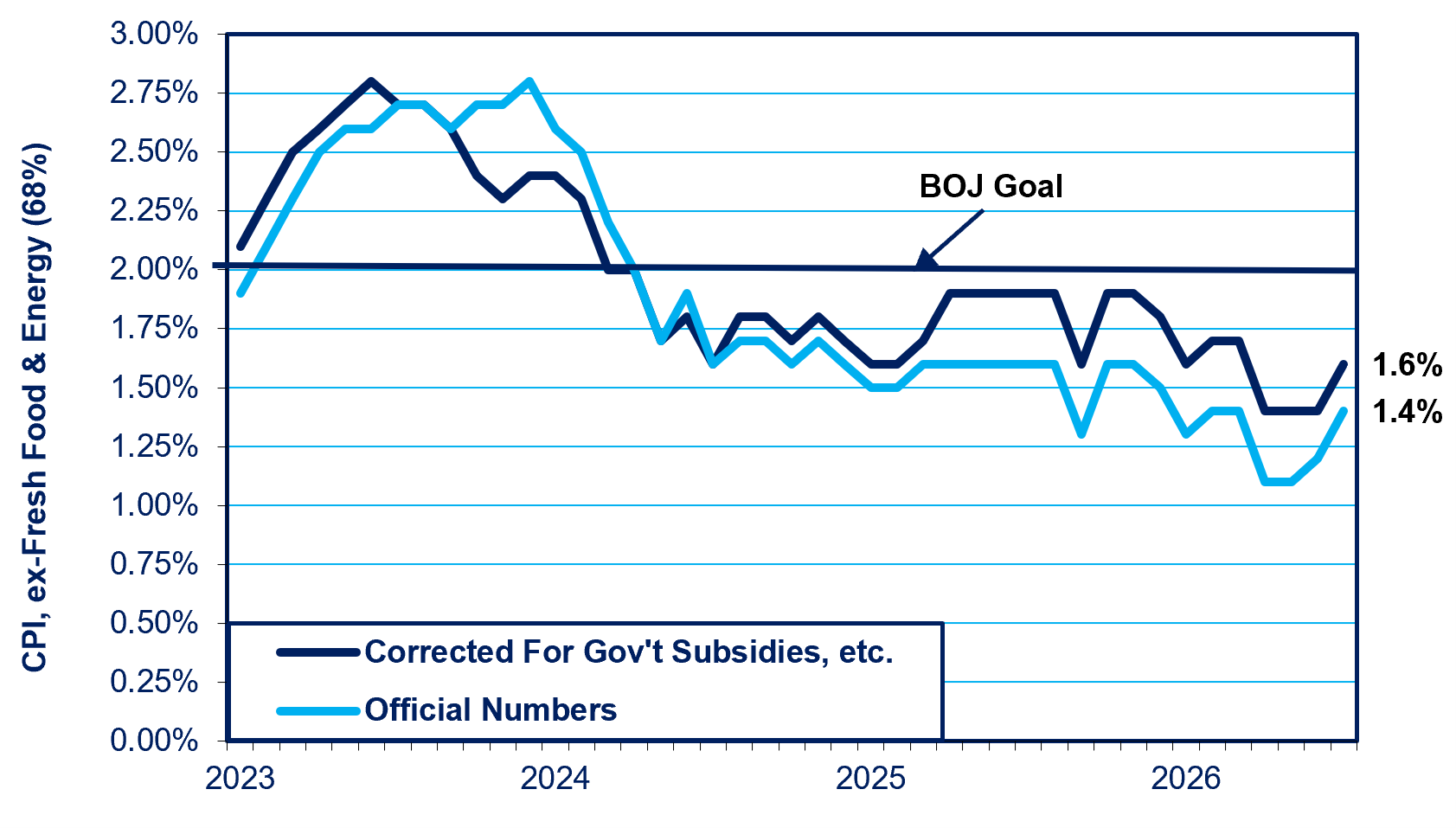
Source: https://www.boj.or.jp/en/research/research_data/cpi/cpirev.xlsx Note: see text for explanation of the two series; 68% in parentheses means the share of the total household budget
The Bank of Japan (BOJ) faces several dilemmas as it meets this Thursday and Friday, but is still expected to raise the overnight interest rate from 1.0% to 1.25%. The biggest dilemma is caused by stagflation. Headline inflation is too high, which would seem to call for a rate hike. The prolonged war in Iran adds to this pressure. But the measure of healthy inflation driven by domestic demand is too low, which would suggest further delay. It also faces conflicting pressures from Washington, which is pushing hard for a rate hike, and the Takaichi administration, which wants to stimulate growth. And then there are signals from weak wages and falling consumer spending, which also seem to weigh against a premature wage hike. Stagflation is a difficult problem for any central bank.
Financial Times Cites Me
I’ll detail these dilemmas below. But first I want to note that, in an article on the pressures facing Bank of Japan Governor Kazuo Ueda, the Financial Times cited my comments.
The article begins: The Bank of Japan and governor Kazuo Ueda are poised to raise interest rates this week to the highest level in 31 years, a decision that must balance domestic economic risks, global market shockwaves and unprecedented pressure from Donald Trump’s administration.
It include my comment: “There’s a lot of pressure on Ueda because this is one of those times where big moves in the market have less to do with changes in economic fundamentals and policy and more to do with market sentiment about what those fundamentals mean,” said Richard Katz, an economist and longtime Japan watcher. He added that Ueda, an academic before he became BoJ governor in 2023, had not shone as a communicator.
After a passage on the possibly conflicting pressures on the BOJ from the Takaichi administration and the US Treasury Secretary Scott Bessent, it quoted another comment of mine: “I don’t think market players or Bessent appreciate the dilemmas facing Ueda,” said Katz. He added that while headline inflation of 2.3 per cent remained above the bank’s 2 per cent target, demand-led inflation was still weak and real wage growth remained low. “Japan faces stagflation,” he said. “That’s tough for any central bank. And I doubt the market would be happy with Ueda emphasising these dilemmas.”
The Dilemmas
The BOJ has begun releasing numbers that compare official inflation figures with what inflation would be like if the government had not added subsidies to reduce the impact of imported inflation in energy and other items on consumers. Instead of seeing high prices at the checkout counter, they face them as taxpayers. This does not make inflation any lower; it just changes the way it expresses itself. In another instance, inflation in the Soviet Union didn’t express itself in prices, but in long lines leading to empty shelves.
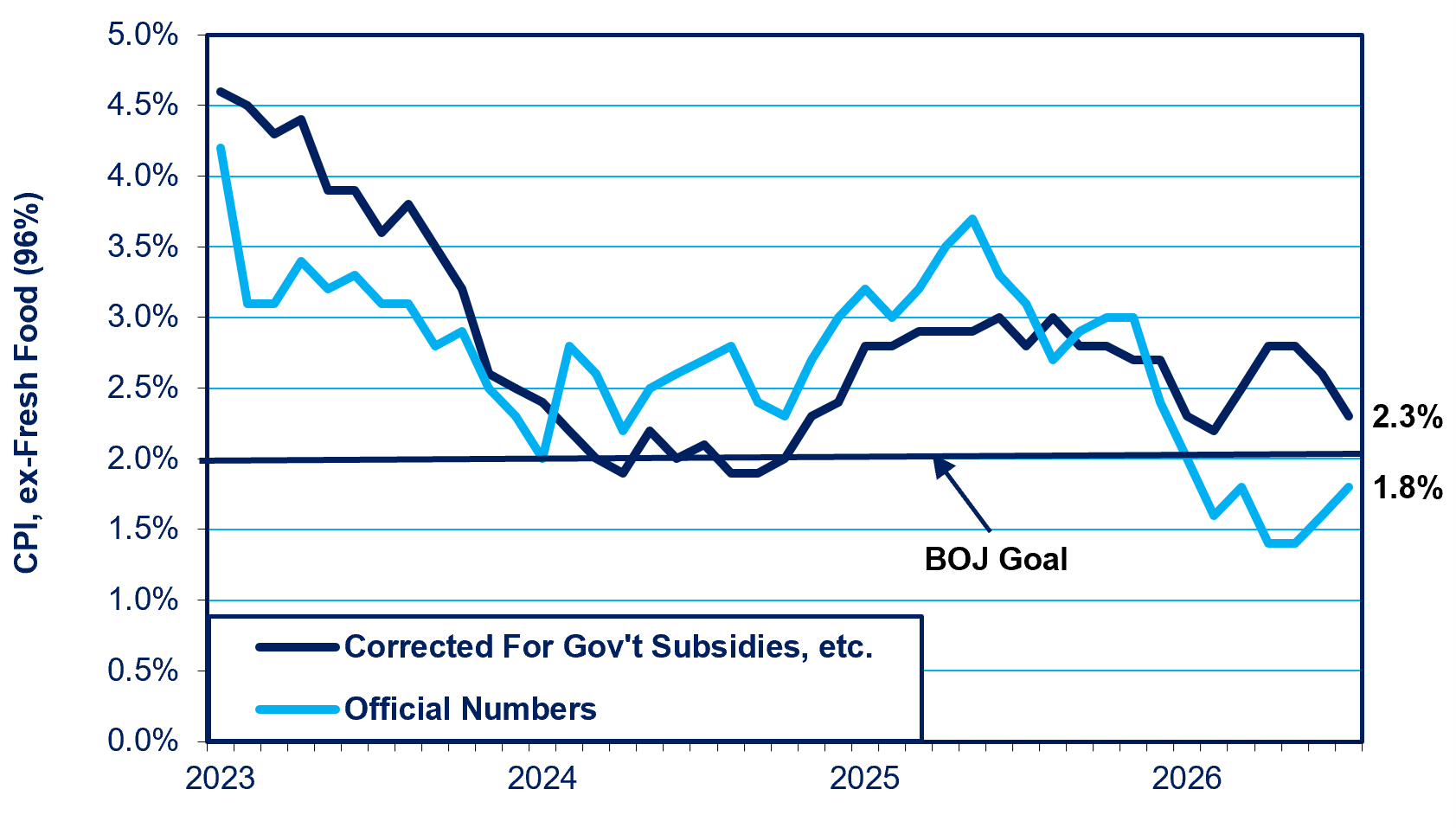
Subsidies have lowered headline inflation, excluding fresh food, to 1.8%; without subsidies, inflation would be 2.3%. These items account for 96% of the household budget (see chart below). The latter figure would seem to call for a hike in overnight interest rates, which is what the BOJ is expected to announce on Friday.
In addition, the hope is that a rate hike would help reverse the yen’s depreciation, a major contributor to imported inflation. But that is not guaranteed, as I discussed in this post.
But if we look at healthy inflation, one led by domestic demand, i.e., all items except import-intensive food and energy, the official inflation figure is just 1.4%. It would be only 1.6% even after correcting for subsidies (see chart at the top of the blog).
In addition, real wages remain weak and have often fallen in recent years despite higher nominal wages (see chart below). This suggests interest rates should remain accommodative.
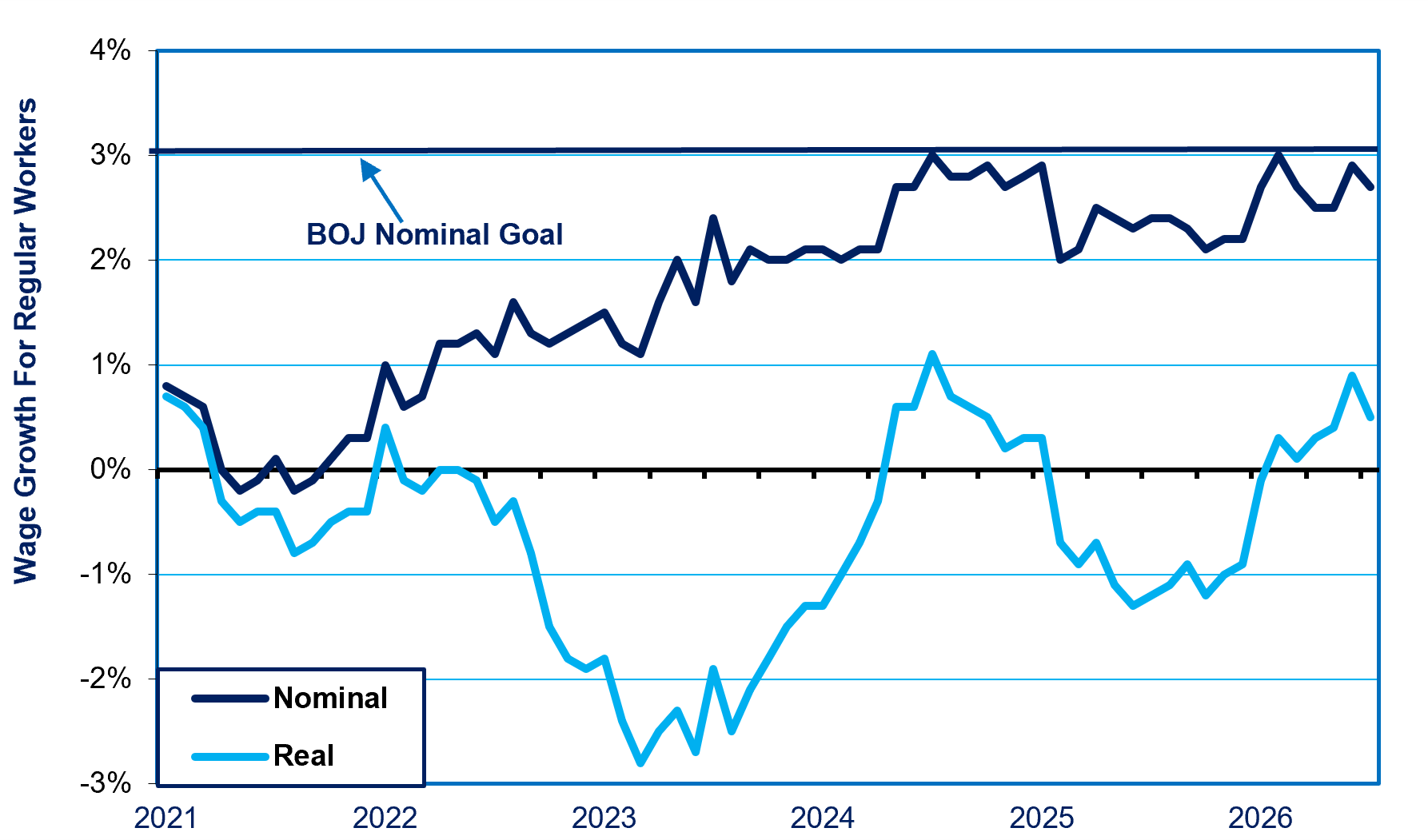
Source: https://www.mhlw.go.jp/toukei/list/30-1a.html Note: Real wages are calculated using BOJ figures for inflation, corrected for subsidies
As a result, Japanese citizens’ consumer spending is 4% below what it was in 2013. Only spending by tourists has kept overall consumer spending from falling. But it is still no higher than it was 13 years ago (see chart below),
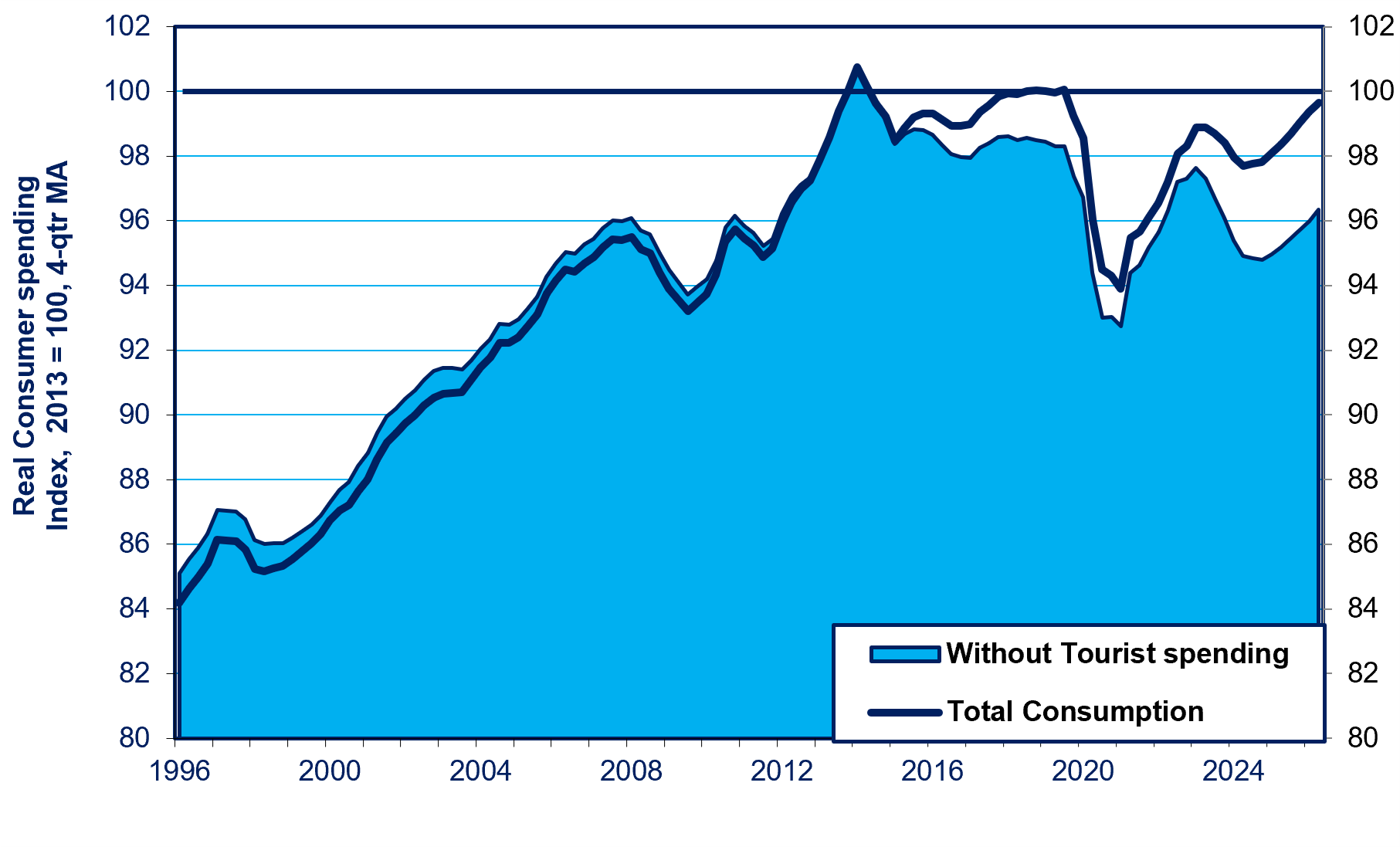
Source: https://www.esri.cao.go.jp/jp/sna/data/data_list/sokuhou/files/2026/qe262_2/tables/kgaku-jk2622.csv
Support the Blog
Paid subscribers are eligible for my new memos, in addition to these regular posts. Beyond that, if you feel you’ve gained insight from this blog, ever restacked it, if you ever subscribed to my previous publication, The Oriental Economist Report, and certainly, if you or your firm have gained insights that helped guide your investments, please support the blog with a subscription or by “buying me a cup of coffee.” You can buy a cup or two on a one-time basis, or once a year, or once a month.


It’s an own goal - the cheap yen drives the price increases in groceries and necessities (most of them imported or strongly dependant on imported inputs) which in turn hurts consumer confidence and spending. As a result the economy is weak and the government opposes any rate hikes which again hits the yen.
Would you recommend a hike or a hold? :)