Alan Greenspan: The Excellent, the Bad, and the Ugly
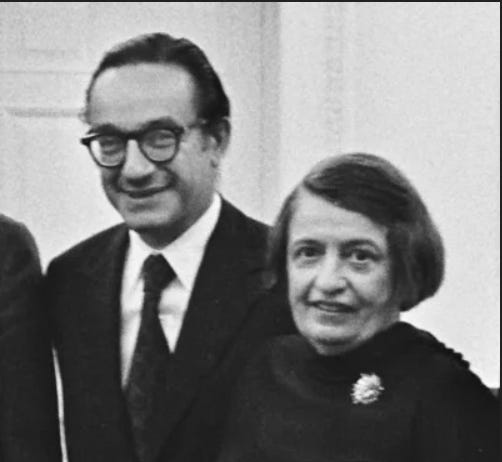
A young Alan Greenspan with Ayn Rand
Alan Greenspan had an immense impact on the American and global economy. Some of that was excellent, and other parts were incredibly damaging.
On the positive side were his decisions on monetary policy, where he was not only guided by pragmatism, but where a supreme number-cruncher—one who even calculated the weight in tons of US GDP—sought truth from data. The result was faster US growth, the strength of the late 1990s productivity revolution, and a needed insurance policy against deflation.
In the latter, he was also guided by the Fed’s study of Japan’s deflation, which indicated that the Fed would have made the same mistakes given its view of Japan at the time.
On the negative side was his abdication of the Federal Reserve’s legal mandate to regulate the financial system, driven by his libertarian ideology. He had been an acolyte of Ayn Rand. At a lunch with regulator Brooksley Born, the head of the Commodity Futures Trading Commission, he said he opposed her efforts to impose strict regulations on derivatives, regulations which might have prevented, or at least attenuated, the 2008 financial meltdown. Born recalled this luncheon conversation.
Well, Brooksley, I guess you and I will never agree about fraud,” Born, in a recent interview, remembers Greenspan saying.
“What is there not to agree on?” Born says she replied.
“Well, you probably will always believe there should be laws against fraud, and I don’t think there is any need for a law against fraud,” she recalls. Greenspan, Born says, believed the market would take care of itself. Ayn Rand had taught that no corporation would commit fraud or produce bad products because that would harm its reputation. So no need for the Food and Drug Administration or the Securities Exchange Commission.
Greenspan was not as extreme as Rand. But he believed it was against Wall Street’s interest to commit fraud, since it would damage the big banks and their shareholders. But his ideology blinded him to a basic principle of economics: the Berle-Means thesis, published in 1932. Banks, indeed, all corporations, do not make decisions. Instead, the individuals running the banks make decisions, and they care more about their self-interest during their short reign than either the long-run interests of the companies they rule over or their shareholders.
The result of Greenspan’s ideology was untrammeled fraud in unhealthy types of derivatives and the worst financial cataclysm since the 1930s. Only swift action by his successor, Ben Bernanke, and the Bush and Obama administrations prevented another Depression. In testimony before Congress, after the 2008-09 disaster, he admitted that his ideology was at fault (see below).
The Maestro In Monetary Policy
In the 1990s, Greenspan, nicknamed The Maestro, said that there was no need to accept a priori the common presumption that the economy’s “speed limit” was 2.5% annual GDP growth and that its non-inflationary unemployment rate was around 6%. Instead, in the new environment produced by the Clinton administration’s deficit-cutting and new innovations in technology, he suggested removing the monetary tourniquets and testing how fast the economy could safely grow. He suggested relying on the results rather than preconceptions. The result was higher growth, a budget surplus, and millions more people with jobs. That created neither a rise in inflation nor a revolt by the “bond market vigilantes.”
The lower capital costs provided by the Clinton- Greenspan efforts were a vital ingredient in the famed productivity revolution. They enabled firms to buy machinery that incorporated the new technology. Business investment rose from an 8.6% share of real GDP in early 1995 to nearly 12% by the end of 2000.
In the early 2000s, he made another crucial decision that proved wise. Because of Japan’s experience, the markets feared deflation. Even though Greenspan thought deflation unlikely, he wanted an insurance policy. His concerns were based on a careful Fed study of Japan’s experience (Preventing Deflation: Lessons from Japan’s Experience in the 1990s). The study showed that, given the Fed’s own forecasts for Japan’s growth and inflation in the early 1990s, the Fed would have pursued an even tighter monetary policy than that of the Bank of Japan. But when it comes to deflation, an ounce of prevention is worth a ton of cure.
Hence, Greenspan chose to err on the side of caution and pursue a low-interest-rate monetary policy to prevent a recurrence of a similar miscalculation in the United States. Despite critics’ Jeremiads, no burst of inflation followed this choice.
A Culprit in the Worst Economic Disaster Since the Great Depression of the 1930s
By contrast, as the chief U.S. policymaker in charge of supervising banks, Chairman Greenspan seemed to operate within a more ideological framework, one that gave excess credence to the desire and ability of financial markets to self-correct. In 1994, for example, a bipartisan coalition in Congress passed the Home Ownership and Equity Protection Act (HOEPA). This act recognized a new financial world, one in which banks no longer kept mortgages on their books, thereby giving the banks a stake in the borrower’s ability to repay the loan.
In the new world, nonbanks generated mortgages that they then sold off to investment banks, which sliced and diced them into mortgage-backed securities. These securities were readily given an AAA rating by the credit rating agencies paid by the issuers. None of these players had any financial stake in ensuring borrowers could repay; they only had an interest in originating as many fee-generating mortgages and mortgage-backed derivatives as possible. Thus arose the no-documentation, no-down-payment loans later nicknamed “liar loans.”
HOEPA enabled, but did not compel, the Federal Reserve to force all mortgage generators and lenders to follow the traditional standards applied to banks: thou shalt not issue a mortgage unless the borrower makes a substantial downpayment, can prove he can repay, and can breathe (yes, in some locations, dead people received mortgages).
However, despite repeated pleading by various officials, including Edward Gramlich, a colleague on the Fed Board, Greenspan refused any significant enforcement of HOEPA. When questioned on this, Greenspan countered that the Fed issued some “guidances,” but these were not mandatory.
Without the unregulated shadow banking system, the bubble would never have become so extreme. Homes were built not for people to live in, but to provide an excuse to issue derivatives. Yet Greenspan, along with the Clinton and Bush administrations and much of the Congress, refused to regulate—or even count—the derivatives.
During Congressional testimony, when Rep. Henry Waxman (D-CA) pressed Chairman Greenspan on whether “your ideology” prevented him from heeding advice to restrain irresponsible lending practices, Greenspan acknowledged, “Yes, I’ve found a flaw [in my economic model]…Those of us who have looked to the self-interest of lending institutions to protect shareholders’ equity, myself included, are in a state of shocked disbelief.”
Only stubborn ideology can explain how Greenspan could say that with a straight face, given that decades of research have highlighted the divergence of interests between shareholders (principals) and managers (agents), and when we live in a world where CEO Stan O’Neal can bring Merrill Lynch to the brink of collapse and still walk away with a $161 million severance package.
Financial Crashes and The Rise of Right-Wing Populism
One final note: Historians have noted that huge financial crashes that destroy the savings of the middle class have often been followed in the US and Europe by a binge of right-wing populism, such as we are seeing today. In a 2018 Foreign Affairs piece commenting of the rise of Trump and other rulers of his ilk, scholars of this issue wrote: “In 2015, we published a study that compiled data on nearly 100 financial crises and more than 800 national elections in 20 democracies since 1870. We found that far-right parties are the biggest beneficiaries of financial crashes. After a crisis, the share of the vote going to right-wing parties increases by more than 30 percent. We also found that government majorities tend to shrink and governing becomes difficult as more parties and anti-establishment groups get into legislatures. These effects turn up in the wake of financial crises but, crucially, not in normal economic downturns.”
Had Greenspan made different decisions, perhaps we would not be living in the age of Trumpism.
More on Greenspan
Here are two pieces I wrote in response to Greenspan. One was published in Foreign Affairs, where I discussed how fraudulent derivatives caused the Great Recession, Greenspan’s refusal to prevent it, and his false claim that no one warned of the danger in advance. The second is from The International Economy, where I discussed both the positives and negatives of his career.

Support the Blog
Paid subscribers will be eligible for my new memos, an addition to these regular posts. Beyond that, if you feel you’ve gained insight from this blog, ever restacked it, if you ever subscribed to my previous publication, The Oriental Economist Report, and certainly, if you or your firm have gained insights that helped guide your investments, please support the blog with a subscription or by “buying me a cup of coffee.” You can buy a cup or two on a one-time basis, or once a year, or once a month.


I like your plain-spoken summary of Alan Greenspan. What's missing for me from all the commentary is what I remember hearing from several women who preceded me in entering the economics profession, women who did their graduate work in the 1950s if I remember right. When Greenspan was running his highly successful consultancy -- for which he is rightly praised as a pioneer in data-saturated business cycle forecasting -- he hired exclusively female economists as his analysts. They were paid little but some got a start in distinguished careers. I remember Paul Samuelson opining many years later about the profit opportunities created by a market that discriminates against women; Greenspan was an economist through and through, and applied this observation to his business long before Samuelson made it.