Restoring Equal Educational Opportunity
Human Capital Is Key To Japan’s Economic Revival
(Earlier this year, I ran several posts critiquing Sanae Takaichi’s industrial policy, saying that it avoided the critical issues indispensable to Japanese revival. It began with this one, followed by this, this, and this. One of the critical issues—and the one I’ll begin addressing today—is human capital, the foundation of all innovation and productivity growth. Whether it’s training managers of small and medium enterprises how to use digital technology, or inducing companies to hire more PhDs and to give all their workers enough training, or restoring equal opportunity in higher education, revival is impossible without ameliorating these problems. In this new series, I’ll try to pose some solutions where I feel I have enough expertise.
By the way, this blog has a search icon on the upper right of the home page where you can look up related items using terms like innovation, digital, human capital, PhDs, etc.)
One of the most admirable and effective features of Japan’s postwar social contract was ensuring equal educational opportunity for all its citizens. As a result, Japan enjoyed one of the world’s best records in social mobility: the ability of its most talented individuals (at least among males) to rise to the top in government, business, and academia. Even those with more smarts than money could ascend by dint of their own talent and drive; they were hardly limited by the socioeconomic status of their parents. A key ingredient in the recipe was equality of education. One cannot imagine Japan’s economic miracle having occurred without this advantage. Japan was kind of lucky to have no oil or minerals, so it had to invest in its one resource: the skills of its people.
Given all this, one of Japan’s saddest statistics is that, these days, a third of high-achieving but socio-economically disadvantaged students say they cannot afford college. While that is no worse than in the typical OECD country, Japan used to be much better.
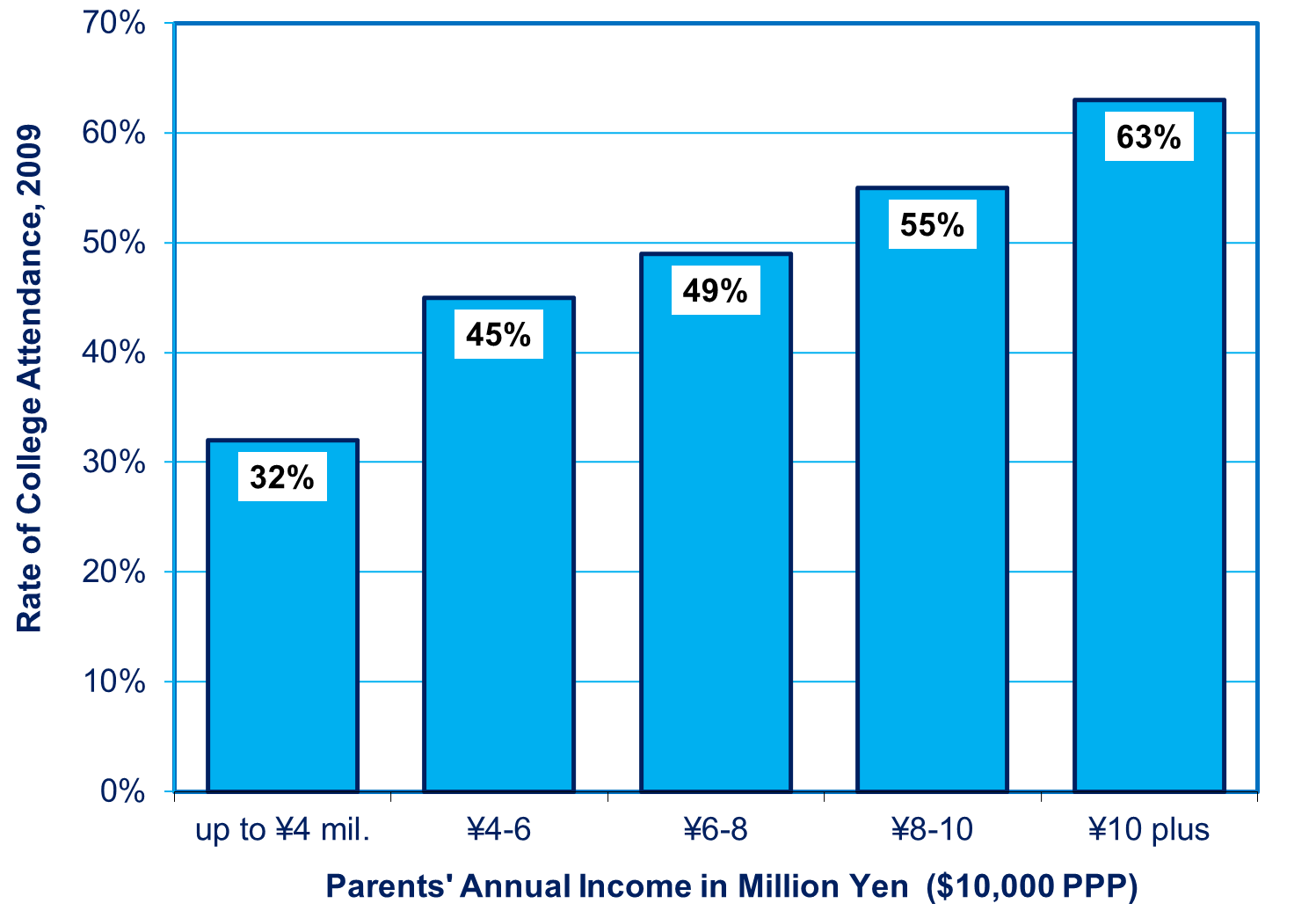
Far more than in the past, income inequality has become a source of education inequality. Only 32% of children in families with less than ¥4 million ($40,000 in Purchasing Power Parity dollars) attend college. By contrast, 45% of those at the ¥4-6 million range, and 55% in the ¥8-10 million range do so (see chart at the top).
Yes, nearly half of all Japanese aged 25 to 34 have college degrees, more than in 30 other OECD countries. However, when the half that gets to go is determined, not by their ability but by their family’s income, that hurts economic growth, not to mention the smart students who lose out.
Tuition is only a fraction of the income barrier. Children of the less affluent cannot afford the after-school tutoring and cram schools (juku) that prepare applicants for the all-important entrance exams to the “right” middle school, high school, and into any university. These successive forks in the road determine one’s career path and lifetime income. Moreover, there is a growing gap between advantaged and disadvantaged children on standardized international tests.
Even when the disadvantaged go to some college, it may not be one of the elite institutions that determine not only the fate of individuals but also who rules the nation. In 2023, 40% of students at the University of Tokyo (Todai) came from families with household incomes above ¥9.5 million ($95,000 PPP). Only 10-12% of all households earn that much. Moreover, the majority came from metropolitan Tokyo or the urban Kansai area.
Todai is, of course, the key grooming ground for future bureaucrats and for many top business leaders. What a contrast to the situation a few decades ago. Back then, when I asked officials at the Ministry of Economy, Trade, and Industry (METI) or the Ministry of Finance (MOF) about their family backgrounds, most of their fathers were ordinary salarymen or self-employed from small cities or even rural areas. Today, they are more likely to tell me that their fathers were bureaucrats or managers at big companies. Todai also ranks first in producing top executives at Japan’s leading corporations.
Consequently, fewer of Japan’s officials and business leaders have direct knowledge of how ordinary Japanese manage day-to-day living. That surely skews their view of which policies are wise. Nor does the country’s leadership get a much-needed infusion of fresh blood with fresh ideas. As in many other countries, the elite increasingly feels like a self-perpetuating caste.
As for the economic impact, study after study has shown that a country’s educational level is critical to its ability to adopt and leverage new technologies. This means not just the ingenuity of a company’s staff but also a cohort of consumers who find new technologies user-friendly and are willing to give new products a try.
Japan is hardly alone in this predicament. 67% of Harvard students come from the top 20% of income earners, and 15% come from the top 1%. Conversely, only 4.5% are from the bottom 20%. But Japan used to be better than it is today.
Why Money Has Become Such a Big Barrier
Given the critical role of education, it is shocking how little the government invests in its people. Only last year did Japan finally pass a law making tuition free for all students in the nation’s high schools, while giving the same amount of yen to help those attending the more expensive private schools. Japan has (very) gradually been moving in this direction since 2010. When the Democratic Party of Japan first proposed moving toward free high school during its brief period of rule (2009-12), the Liberal Democratic Party (LDP) denounced it as a waste of taxpayer money. As affordability increasingly became an issue, the LDP very gradually relented.
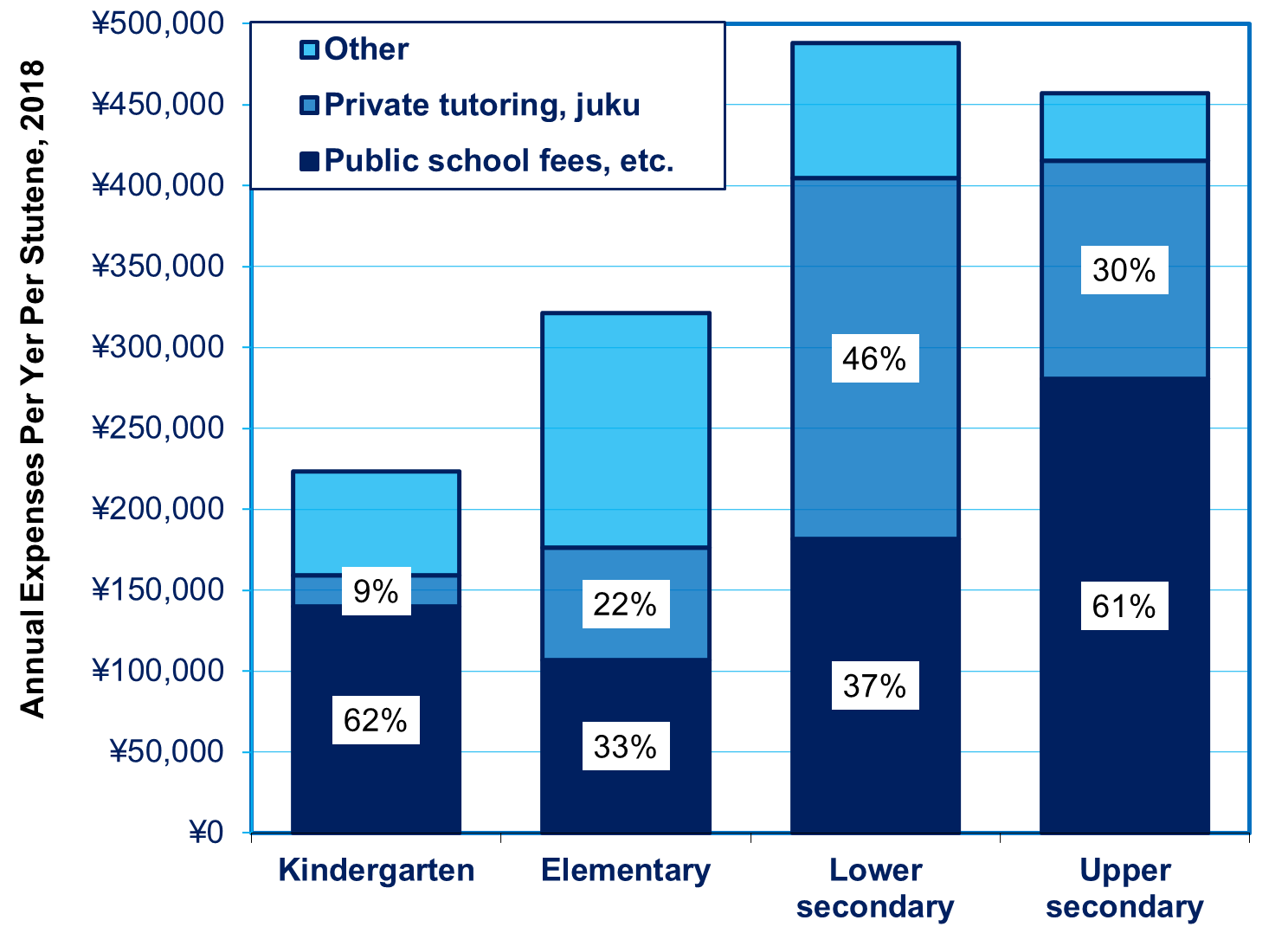
Tuition accounts for only 43% of the ¥5 million ($50,000 PPP) that the family has to pay toward the cost of public school from kindergarten through high school. There are all sorts of fees and expenses, from uniforms to computers to assorted activities. And then there are the long hours of costly after-school private lessons needed for the entrance exams that determine where one goes to junior high, then high school, and whether one even gets into a university. Altogether, in 2018, the average family paid more than ¥300,000 ($3,000 PPP) per year for primary school and ¥400-to-500,000 ($5,000 PPP) for middle school and high school (see chart below).
Source: https://www.mext.go.jp/content/20202419-mxt_chousa01-000005405_19.xlsx
Costs have increased since. According to the 2021 Child Learning Expenses Survey by the Ministry of Education (MEXT), annual private tutoring costs for public junior high and high school students alone amount to around ¥360,000 ($3,600), excluding other expenses and fees. All these household expenses add up to at least 6-7% of the income of households with children, and some say the figure is higher.
No wonder parents in Japan (and South Korea) say that the high cost of educating even one child is a major reason Japanese mothers, on average, now have just 1.15 children. One scholar citing this data advised Tokyo and Seoul to adopt a “reverse one-child policy.”
Why do so many parents invest so much in the costly cram schools (juku) and other forms of private afterschool lessons? Because college grads with regular employment earn 36% more than high school grads with regular employment. As they age, the gap grows. At age 55-59, they earn 63% more. With acceptance rates at colleges averaging just 60% a couple decades ago, a marginal difference in one’s score can have a huge impact on the rest of one’s life. The differential is even higher for women. College can also make the difference between getting a regular or non-regular job, and the latter can pay less than half of regulars’ pay, not to mention the missing bonuses and lack of job security.
Going to the “right” college makes an additional difference. The scholar cited above reported that graduates of a high-ranked university earn over 10% more than graduates of a lower-ranked one, even if they have the same pre-college exam scores. The declining population has led many colleges to accept students they would have rejected 20-30 years ago—the acceptance rate is 90% these days—but the better ones remain very competitive.
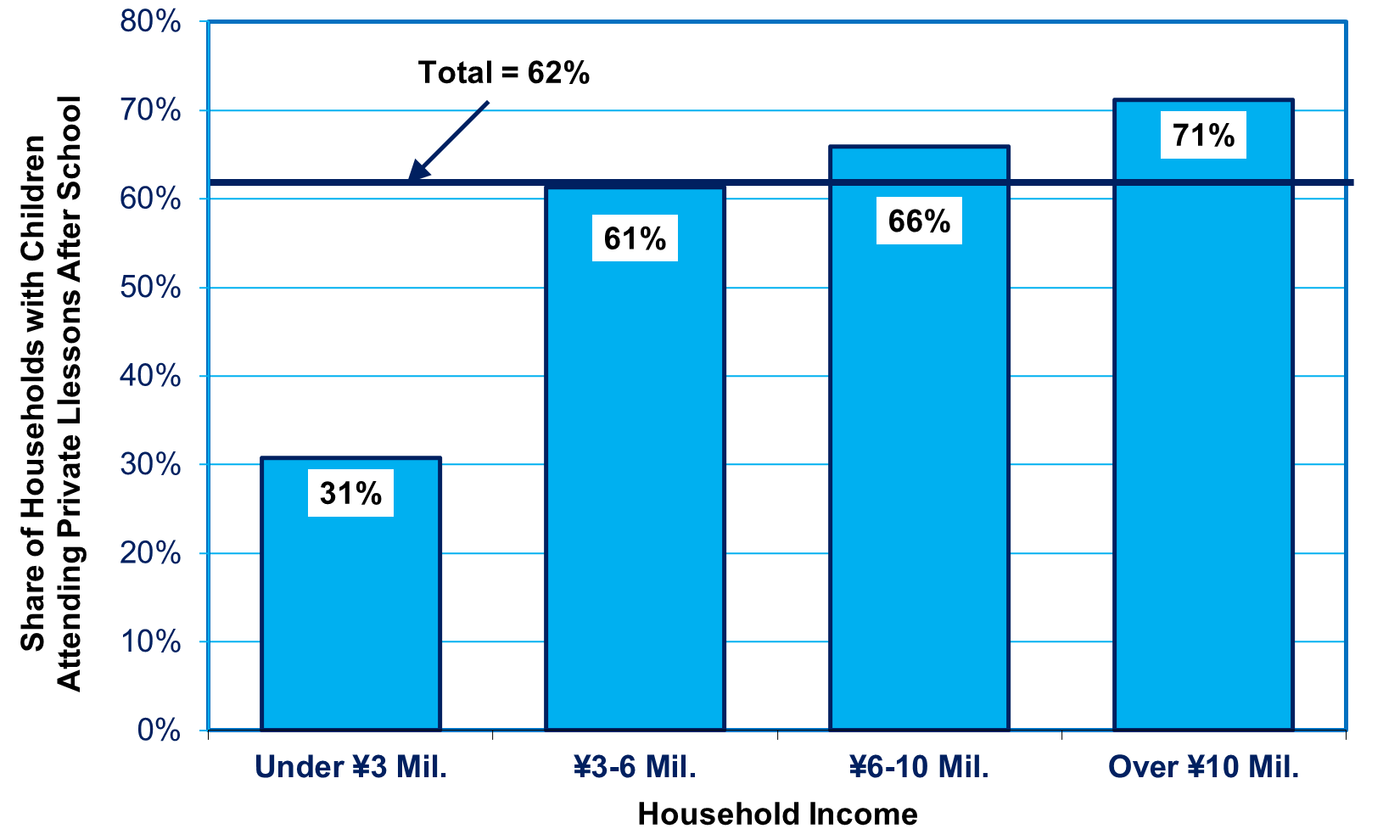
While all parents would like to give their children this advantage, not all can. As with college attendance itself, the share of households investing in private lessons is a function of income. Among those earning under ¥3 million per year, just 31% can invest in private lessons, a share that rises to 66% among in the ¥6-10 million ($60-100,000 PPP) bracket (see chart below).
Source: https://www.japantimes.co.jp/news/2025/05/15/japan/society/enrichment-lessons-survey/
Most parents do not sign their children up for the expensive and stressful juku where students may spend an onerous 4 to 5 hours after school. 27% of households have their children do that; others pay for less expensive tutoring and shorter hours.
Government Pays Small Share of University Costs
80% of college students go to private universities. At public universities, tuition is around ¥642,000 ($6,400 PPP) except for some specialized courses. This was an increase from the longstanding tuition of ¥535,000. At private colleges, tuition averages around ¥1.5 million ($15,000 PPP) per year. While these amounts seem low compared to the US, they are higher than in Europe.
Then there is the “enrollment” fee, a nonrefundable fee ranging from ¥200,000 to ¥300,000 for each college that accepts. If, like many students, you apply to 3-4 colleges to make sure you get into at least your fallback school, you’ve laid out ¥800,000 to ¥1.2 million ($12,000 PPP) just to make sure you get in somewhere. While the Education Ministry recommended last June that colleges refund this fee to those who don’t enter, compliance is low. With a shrinking college-age population stressing the finances of many private colleges, they don’t want to give up any funds.
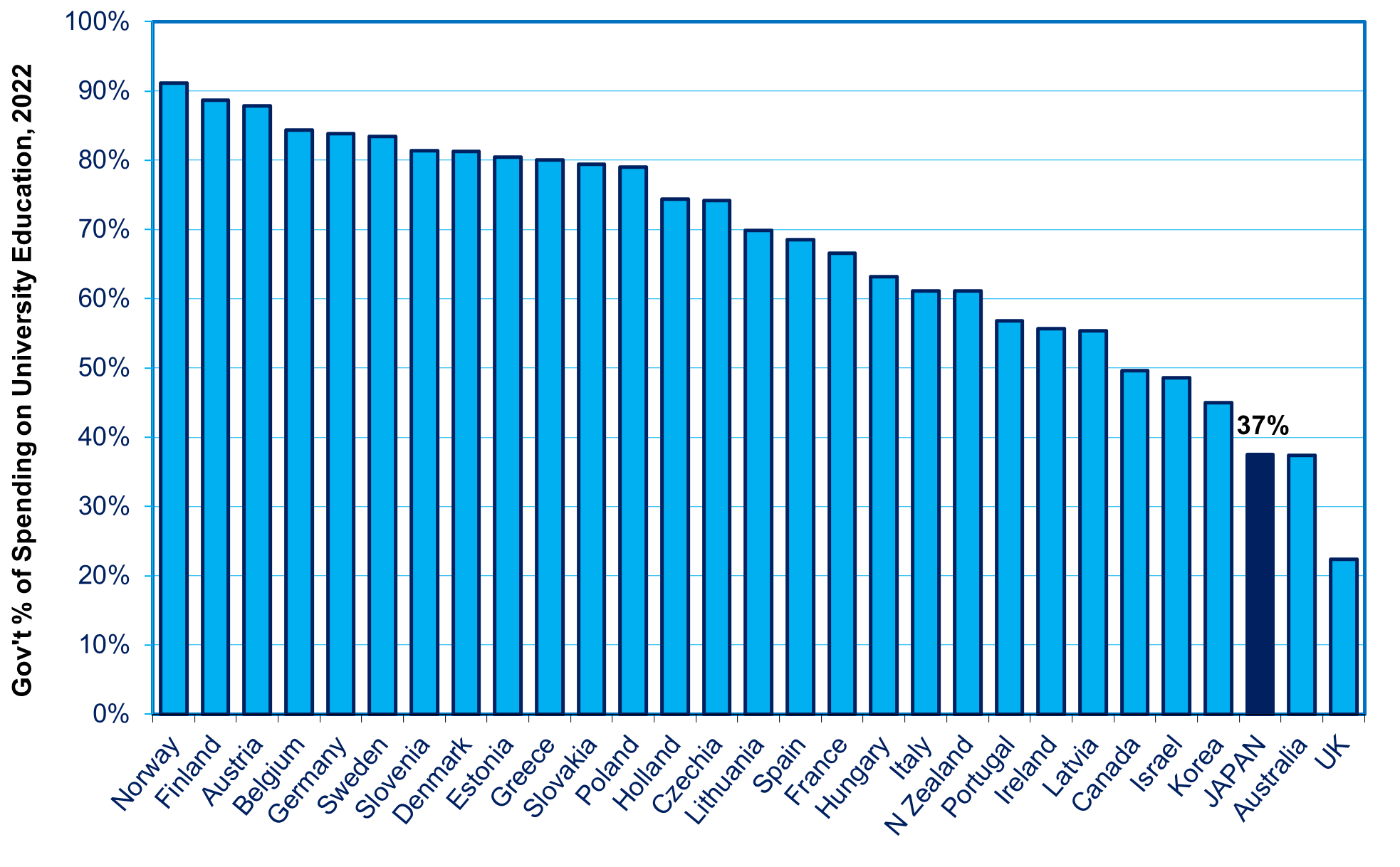
The government covers only 37% of the cost of getting a bachelor’s degree, the third-lowest among 29 OECD countries (see chart below). I’ll assess government aid in a later post.
Source: OECD at https://tinyurl.com/yrhpccc3
There’s one final issue, one I had encountered when I taught as an adjunct at the State University of New York. A lot of my students had to work a considerable number of hours to help support themselves (far more than the two nights a week I drove a cab in New York during college). That limited their study (and sleep) time. I see many students like them at the convenience stores in Japan. Some younger people don’t go to college because they must work full-time.
Throwing Money At the Problem
There are a lot of problems that one cannot solve “just by throwing money at the problem.” But there are some you can. If Prime Minister Takaichi thinks more fiscal spending will save Japan, why not spend it on an investment that yields real returns: improving the ability of talented but less affluent families to afford the excess fees charged in the primary school through high school and to attend good colleges? Some important government aid is available only to parents with three children in school, and that’s true in only 12% of households. Details in a later post.
Coming in Part II: Japan’s era of equal education opportunity and how it was lost.
Paid subscribers will be eligible for my new memos, an addition to these regular posts. Beyond that, if you feel you’ve gained insight from this blog, ever restacked it, if you ever subscribed to my previous publication, The Oriental Economist Report, and certainly, if you or your firm have gained insights that helped guide your investments, please support the blog with a subscription or by “buying me a cup of coffee.” You can buy a cup or two on a one-time basis, or once a year, or once a month.


"you’ve laid out ¥800,000 to ¥1.2 million ($1,200 PPP) just to make sure you get in somewhere."→Shouldn't that be $12,000 PPP?